
RECENT POSTS


Recommended Products

Premium Polyester
Artificial Banana Plant | 109 cm | 3 Stem | 7 Leaves | With Basic Pot
Rs. 3,999.00
Rs. 6,999.00
In Stock

Premium Polyester
Artificial Areca Palm Plant | 105 cm | 27 Leaves | 3 Stem | With Basic Pot
Rs. 3,999.00
Rs. 7,999.00
In Stock
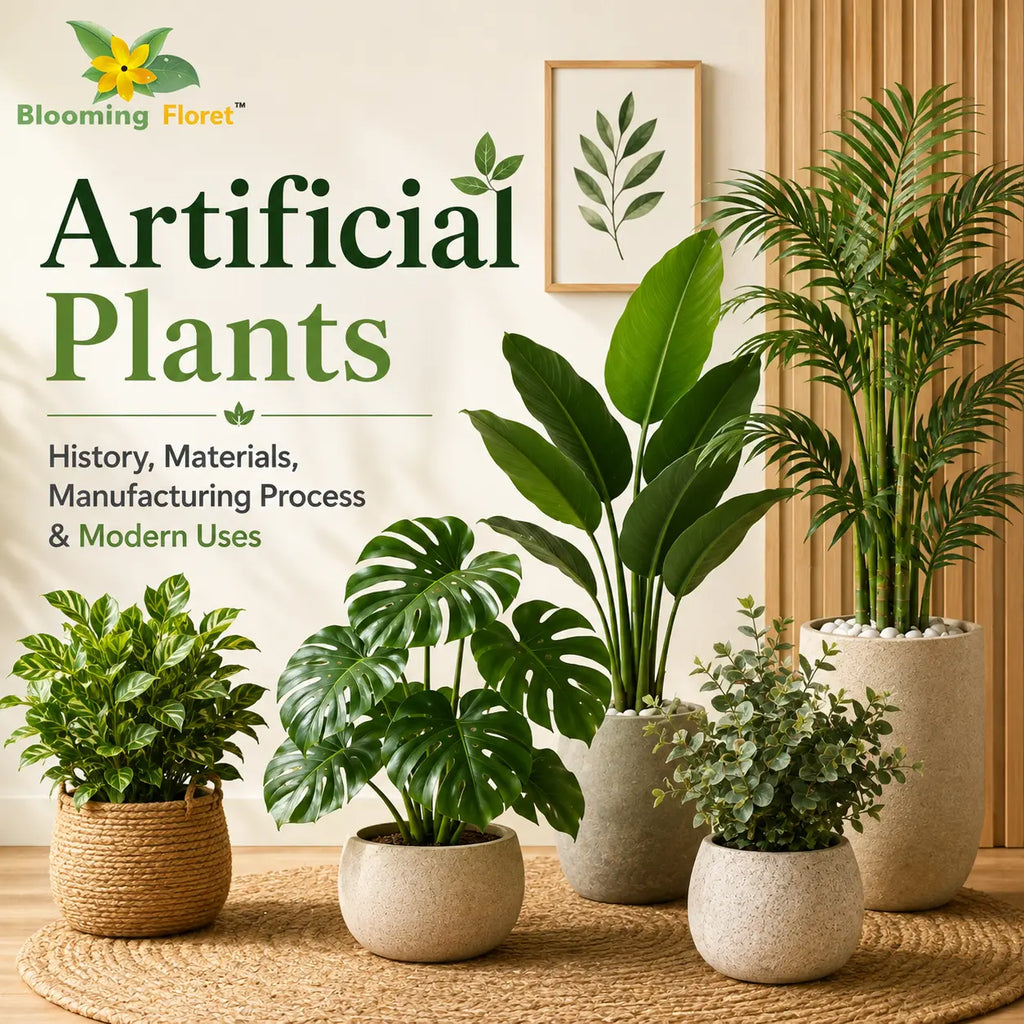
Artificial Plants: History, Materials, Manufacturing Process & Modern Uses
Look around any office, hotel, or even someone's living room today, and it is very likely that you'll come across a green plant you see in this context that is an artificial one. Artificial plants have definitely been the main decor item for both homes and offices in the last few years. They have been getting so close to the original that most people can hardly distinguish them simply by viewing from the surface. Earlier faux plants looked stiff and plastic-like. Well, they are no longer in the situation. Current products come with natural leaf patterns and colour gradients as well as stems that look and feel very close to real ones. This blog will explain the origins of artificial plants, the materials from which they are made, the manner of producing them, and last but maybe most importantly, why so many people are choosing them over real plants these days.
What Are Artificial Plants?
Artificial plants are fake versions of real plants; some people call them faux plants and are usually used to add a natural look to a room without all the mess that is involved in keeping the real plant alive. They are made from synthetic materials like plastic, silk, or foam instead of real leaves and stems. These kinds of plants are used mainly for decor purposes only, and companies use different materials today to get varying results in looking real and durable.
Common Uses of Artificial Plants
You'll spot these almost everywhere now:
-
Homes, mostly living rooms and bedrooms
-
Offices
-
Hotels and lobbies
-
Restaurants and cafes
-
Hospitals, since real plants aren't always practical there
-
Retail stores, for display purposes
-
Weddings and events
History of Artificial Plants
-
Materials Used Through the Ages
Long before the first use of plastic to make fake flowers, different cultures created their own versions of decorative plants using materials that are locally available. In Egypt's early days, people made flowers out of painted linen and thin slices of dyed horn. When it came down to how the Romans wanted their flowers to look at home; they decided they wanted to do it fancy. Because of this, they made them out of gold and silver. In China, pith paper became the standard for making delicate flowers, while in Italy, they used pieces of silkworm cocoons. In South America craftsmen who were very much into nature would take feathers of different colours and use them to make flowers. Some of the craftsmen there also used wax and tinted shells.
It's surprising but fascinating that so many different kinds of civilisations were able to come up with their own variations of the same concept of indoor greenery even before plastic came into our world and the factories started producing it.
-
Early Origins in Ancient Egypt
Many people believe that artificial plants are a modern invention. But some of the artificial plant designs today are actually very similar to the ones made by ancient Egyptian artisans who created plant-like shapes in linen thread and painted wood. They were first and primarily used as part of decoration and religious functions. Despite their limited realism versus today's standards, they had deep symbolic meanings and were regularly put into tombs. A lot of work was put into the manual production of these things.
-
Development in China
China was a large contributor to advancing this craft, in particular using silk. Thanks to the Chinese craftsmen, the state became famous for producing complex patterned silk layers of flowers and leaves, using their expertise in silk weaving to produce fine and realistic items for their time period. Now this silk work has become a feature for decorative plants throughout Asia.
-
Popularity in Europe
Once they made it to Europe, silk flower arrangements got very popular in interior decoration, mainly among the high-class families. With silk flowers you get the straight, tree-green leaves all year long, since this is something real flowers simply could not do at the time. Evolution to Modern Artificial Plants
-
Evolution to Modern Artificial Plants
Nothing really changed until plastic manufacturing developed in the 1900s. They could be produced in mass and cheaply using machines, but the style was stiff and artificial-looking. You can see that they started using modern techniques like nylon netting stretched over wire for the stem, injection-moulded plastic for the bud structure, etc.
Polyester still has been the standard material for art structures and lowers since the 70s, but although it hasn't changed a great deal, it is amazing what we have now. If you have to touch it, you sometimes just can't tell.
Materials Used to Make Artificial Plants
The material used really decides how real a plant looks and how long it holds up. Cheap materials fade fast or just look plastic-y, while better materials can actually fool your eye.
|
Material |
Appearance |
Durability |
Indoor/Outdoor |
Maintenance |
Cost |
|
Polyethylene (PE) |
Natural |
Excellent |
Both |
Low |
High |
|
Polyester |
Good |
Good |
Indoor |
Low |
Moderate |
|
PVC |
Good |
Excellent |
Both |
Low |
Affordable |
|
Silk |
Premium |
Moderate |
Indoor |
Moderate |
High |
|
Latex |
Highly realistic |
Good |
Indoor |
Low |
Premium |
|
Foam/Fabric |
Decorative |
Moderate |
Indoor |
Low |
Moderate |
|
Preserved Natural Materials |
Natural |
Moderate |
Indoor |
Low |
Premium |
Most Common Materials:
-
Polyethylene (PE) is one of the best options available, as it is very realistic. It handles the sunlight well, which means it can be used both indoors and outdoors, and also the colour remains vibrant for a long time.
-
Polyester is often used for the production of plants and flowers for interiors. It is relatively low in price and looks good, but it will fade faster under the UV ray of the sun than polyethylene would.
-
PVC is strong, durable, and cheap. It is commonly used for making artificial hedges and vines, mainly in outdoor settings when cost-effectiveness is more important than an ultra-high level of realism.
-
Silk produces the feeling of a very soft, premium-quality surface, mainly when it comes to the production of flowers and delicate leaves. Its main disadvantage is that it breaks down when exposed to the sun. So, generally it is placed indoors.
-
Latex gaining popularity is because it helps the creation of realistic surface textures. For that reason, it is mostly used in the higher-end artificial plants, like when one seeks complete similarity with actual plants.
-
Foam and fabric are lower-cost decorative items that are typically produced with the aid of foam and fabric, where the appearance of something exactly realistic is not the main goal.
-
Preserved natural materials are in fact real plants that go through a preservation treatment to prevent them from rotting. Naturally, they have to be priced much higher than other materials, as the final outcome is extremely close to what you would find in nature.
How Artificial Plants Are Manufactured
Making a good-looking artificial plant actually takes several steps before it reaches the store.
Step 1: Plant Design and Mold Creation
Manufacturers begin by closely studying plants, observing leaf shape, stem structure, and the proportions of different parts. Based on these observations, moulds for each plant part are produced.
Step 2: Leaf and Stem Molding
Thanks to these molds, leaves and stems can be made from whichever material manufacturers want to use: PE, PVC, silk, etc. This procedure mainly aims at achieving the correct shape and texture.
Step 3: Coloring and Vein Printing
After the leaves get their form, they are painted with a set of different colours to replicate the colour variations one usually sees on actual leaves. With printing veins, the small yet characteristic natural lines typical of a real plant leaf are produced.
Step 4: Creating Branches and Stems with the Leaves
The leaves and stems are then attached onto branches using glue. To be able to bend and to shape the leaves naturally, a metal wire is placed down the stems.
Step 5: Planting and Decorating
Then, a plant is put into a pot, and to make it look real, it can also be covered with soil-like filler. The plant is decorated at this stage as the last step, too.
Step 6: Quality Assurance
The plant must then be examined before it is dispatched. The assessment focuses on the plant's colour, strength, and how authentic it looks.
Benefits of Artificial Plants
There's a good reason so many people are switching to fake greenery:
- No watering-ever problem
- No sunlight needed, so you can place them anywhere
- Good for people with allergies to pollen or mold
- Lasts a long time
- Barely any maintenance; just dust it once in a while
- Saves money over time compared to replacing dying real plants
- Great for offices and shops that want consistent greenery
- Looks the same no matter the season
Environmental Impact of Artificial Plants
A quick look at both sides of the coin is required because these plants aren't perfect either. What's good is that they last a really long time, so they don't require a replacement as much, and they are reusable and can be used elsewhere.
They sure help save water consumption and are low-maintenance when compared to real plants. Yet, the bigger concern seems to be the plastic waste problem, since most man-made plants are produced from non-degradable materials.
In addition, recycling is a complex matter. The process of producing fake plants leads to emissions of greenhouse gas. A few better and more sustainable options have started popping up, such as the use of recycled paper material, the application of less-impact manufacturing techniques, and packaging that can easily be recycled.
Artificial Plants vs Real Plants
This is really the big question most people have before buying: do you go real or fake? Here's how they actually stack up against each other.
|
Feature |
Artificial Plants |
Real Plants |
|
Maintenance |
Very Low |
High |
|
Lifespan |
Years |
Depends on care |
|
Water Requirement |
None |
Regular |
|
Sunlight |
Not Required |
Essential |
|
Air Purification |
No |
Yes |
|
Allergies |
Allergy-friendly |
May trigger allergies |
|
Initial Cost |
Moderate |
Lower |
|
Long-Term Cost |
Lower |
Higher |
|
Sustainability |
Depends on materials |
Naturally sustainable |
Natural plants have the effect of cleansing the air as well as being very appealing to the eye, so they seem like something natural, but they do require you to water them regularly and keep their surroundings brightly lit, and you have to be patient, as they may not grow or bloom overnight. But artificial plants can eliminate all those concerns; you just put them once there, and they continue to look brand new for years without any need to water, no dead leaves, and, sure, no need to worry about sunlight.
Real plants may appear to be cheaper at the outset, but they will add up to the total you have to spend with new purchases and maintenance; on the contrary, fake plants will come with a higher price tag initially, but soon they will pay you back in savings since there is nothing to take care of.
How to Choose High-Quality Artificial Plants
Some artificial plants are just a waste of money. Here are pointers when you select the right ones:
- Leaf texture: Check with your hand; a low-cost plastic feels very different from high-quality stuff
- Color differences: Real leaves don't have only one level of color, so fake ones should not have a single
- Material that stands up to UV rays: This is very important for fake plants that are next to a window or outdoors because UV rays can fade the colour.
- Hardy, strong stems: The stems should carry the shape, not bend or look awkward
- Heavy-duty pots: A solid base contributes to the authenticity of the whole setup.
- Fading resistance: In this way, after a few months, the colour doesn't become dull.
You can rely on brands that have been around, which usually stand for good material and quality controls in their plant-making process
Maintenance Tips for Artificial Plants
These low-maintenance products will look beautiful for a long time with just occasional care:
- Wipe the surface from time to time with a cotton cloth
- Clean them with care; do not use corrosive cleaners
- If unused, put them somewhere safe, far away from hot areas or wet rooms
- Take UV-blocking ones if you have to keep them outside
- When the colors lose their vibrancy or if the material starts to crack, that will let you know when it needs to be changed
Conclusion
Plastic plants have evolved quite a lot since the handmade ones from fabric and feathers; now we have very realistic plastic and latex materials for artificial plants. The quality of the material determines how real and durable it is. Granted, there are some environmental consequences on one hand, but the low maintenance and truth is it maintains its beauty all through the seasons, making artificial plants a very convenient option for homes and offices. If you dream of having lush greenery in your space without the hassle of tending to it, an artificial plant of high quality is definitely worth your investment.
FAQs
How long do artificial plants last?

Good ones can easily last several years, sometimes even up to a decade, without losing their look.
Are artificial plants recyclable?
Some materials can be recycled, but it depends on what they're made from. Certain plastics recycle better than others.
Can artificial plants be used outdoors?
Yes, but pick ones made for outdoor use, like PE or PVC, since they handle sun and weather better.
Which material looks the most realistic?
Polyethylene and latex are usually the most realistic, with natural texture and colour that closely matches real plants.
Do artificial plants require maintenance?
Barely any. Just the occasional dusting and gentle cleaning keeps them looking fresh.


